6 Actually Unusual Things to Do in Marrakech For the Brave Only

Most articles about Marrakech repeat the same list: Majorelle Garden, Bahia Palace, a souk tour, and riad photos.
These are beautiful things, of course, but they’re not all Marrakech has to offer. There’s another city living in the background: strange food, neighborhood hammams, local habits, and experiences that only those who want to live Marrakech as it really is—without filters—would approach.
This article is for you if you’re saying to yourself: “I’ve visited Marrakech before, or I don’t want a standard tourist program.
I want something truly different.” What you’ll read here isn’t from a tourist brochure, but from countless visits to Marrakech and personal experiences—some delicious… and some that require a bit of courage.
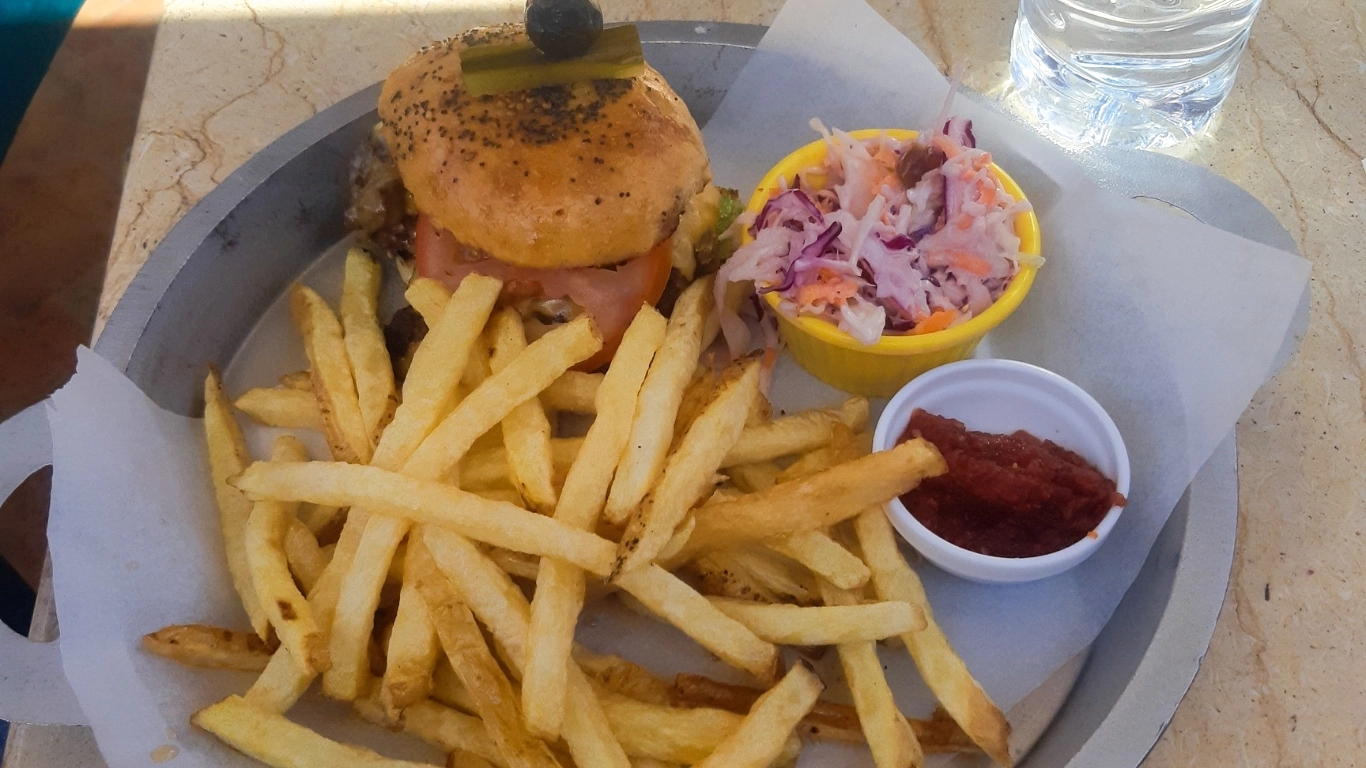
Camel Burger at Café Clock
If you think camels are only for riding in Agafay, let me tell you that you can literally eat one right here in Marrakech.
But the key is to try it at a trusted place like Café Clock, a café and restaurant mentioned on international websites where tourists come specifically during their tours to eat it.
Personally, I had an unusual experience with it the first time I came to Marrakech—it was also the first time I used Google Maps in those narrow, tangled alleys, which made the adventure delicious: a bit of getting lost, then a reward at the end.
Getting from Jemaa el-Fnaa Square to Bab ksiba, where the café is, took me at least half an hour on foot (not counting the detours), but the ending was worth it.
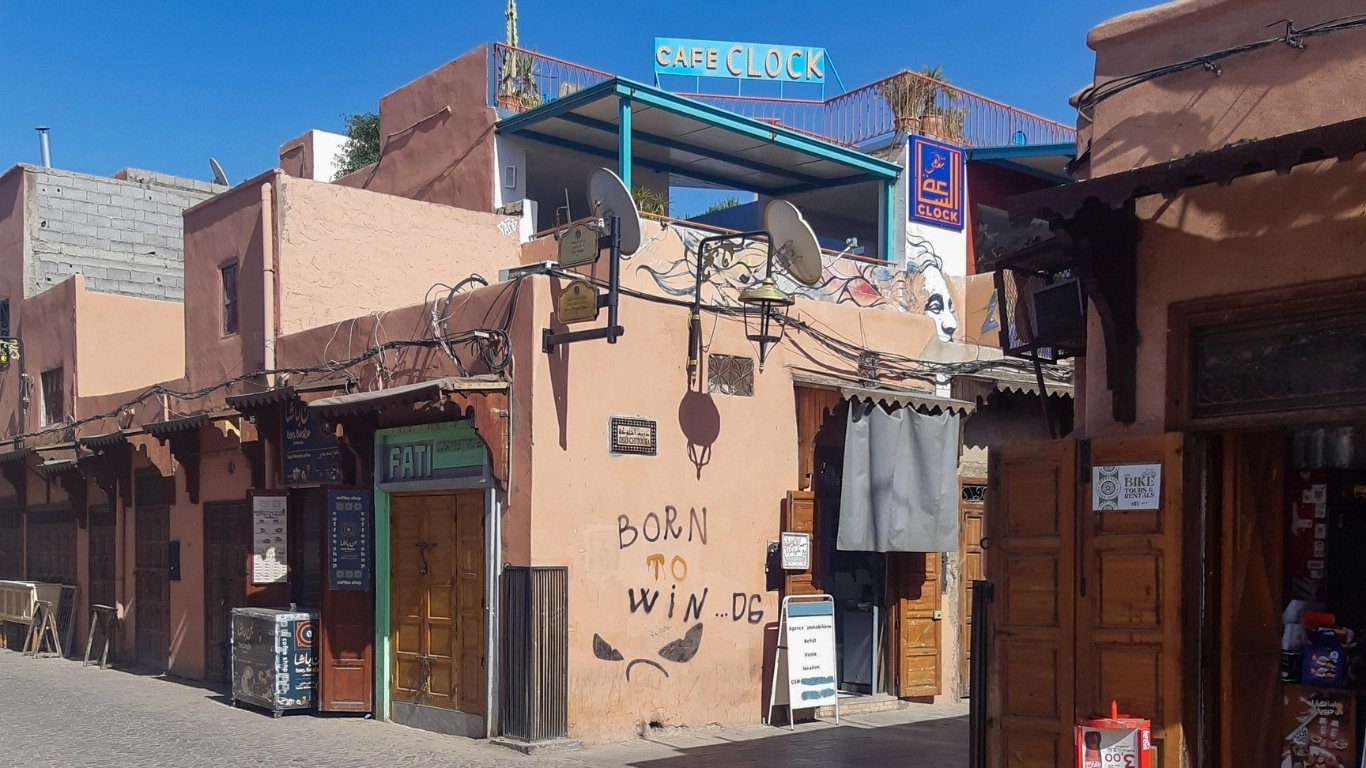
When I finally reached the café and took my first photo, I felt like I’d “won the round.”
Advice: If you enjoy walking and discovering alleys, I recommend following my same path from Jemaa el-Fnaa. But if you’re older, in a hurry, or simply don’t want the adventure, you can take a horse-drawn carriage from Jemaa el-Fnaa to Bab ksiba as the closest point to the café.
After your adventure, you’ll need a good place to rest – consider staying at one of the affordable riads in Marrakech near the Kasbah area.
How did it taste?
The order took about 20 minutes. The dish was a camel meat burger sandwich, with a taste close to beef but deeper and slightly stronger flavor, with salad and french fries.
The strange thing was that everything in the dish leaned toward a light sweetness (the sauce, bread, and even the seasoning), but it was sweetness in the right place that made the flavor different and enjoyable.
In the end, it was an unusual experience: an adventure in Marrakech’s red alleys, and an unforgettable delicious reward. I’ll definitely repeat it next time.
Notes and precautions:
Suitable for meat lovers. If your stomach is sensitive, avoid eating it with a heavy meal on the same day.
Snail Soup (Babbouche)
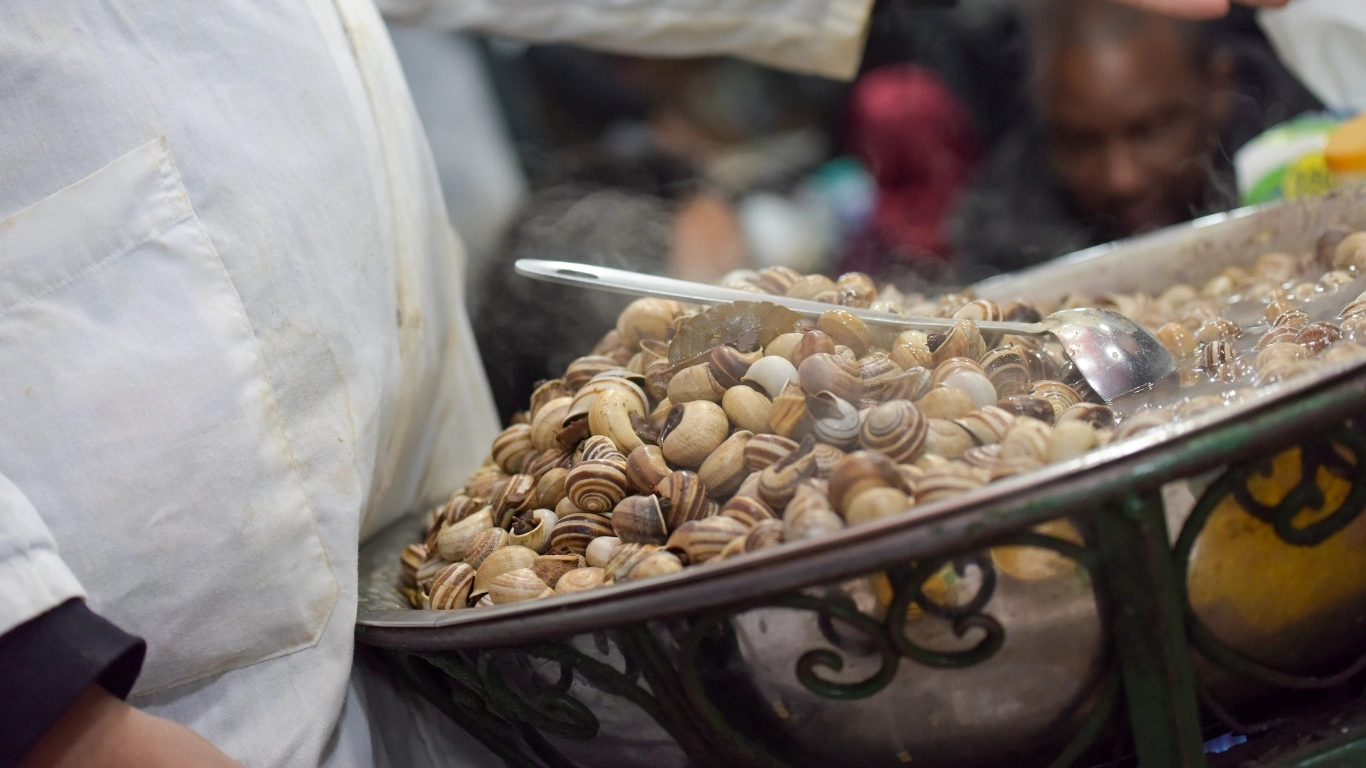
Another unusual—or rather unexpected—experience. Who would think Moroccans eat snails? But it’s true, especially in winter, as it’s said to “warm” the body and help fight colds.
Babbouche is probably the only thing we share with some Asian cultures in terms of “strange eating,” but for us, it’s part of popular culture, especially at night in the squares.
Personally, I don’t have enough courage to eat the snail itself, so I stick to the hot broth mixed with several spices and herbs. For me, it’s perfect for winter, and I don’t hesitate to try it when the weather gets cold.
How to eat it?
The vendor will give you a small bowl or cup of hot broth made from herbs and spices, with small cooked snails inside, along with a wooden stick to extract the snail from its shell.
You can simply stick to the broth if you’re not comfortable with the idea of eating the snail itself.
Important advice: Don’t swallow the snail whole without thinking. Just eat the soft front part, and leave the back part.
Where to eat it?
In Jemaa el-Fnaa Square after sunset, you’ll find large metal carts with steaming pots and piles of snails. Just follow the hot broth smell.
Sheep’s Head: Food for Strong Hearts
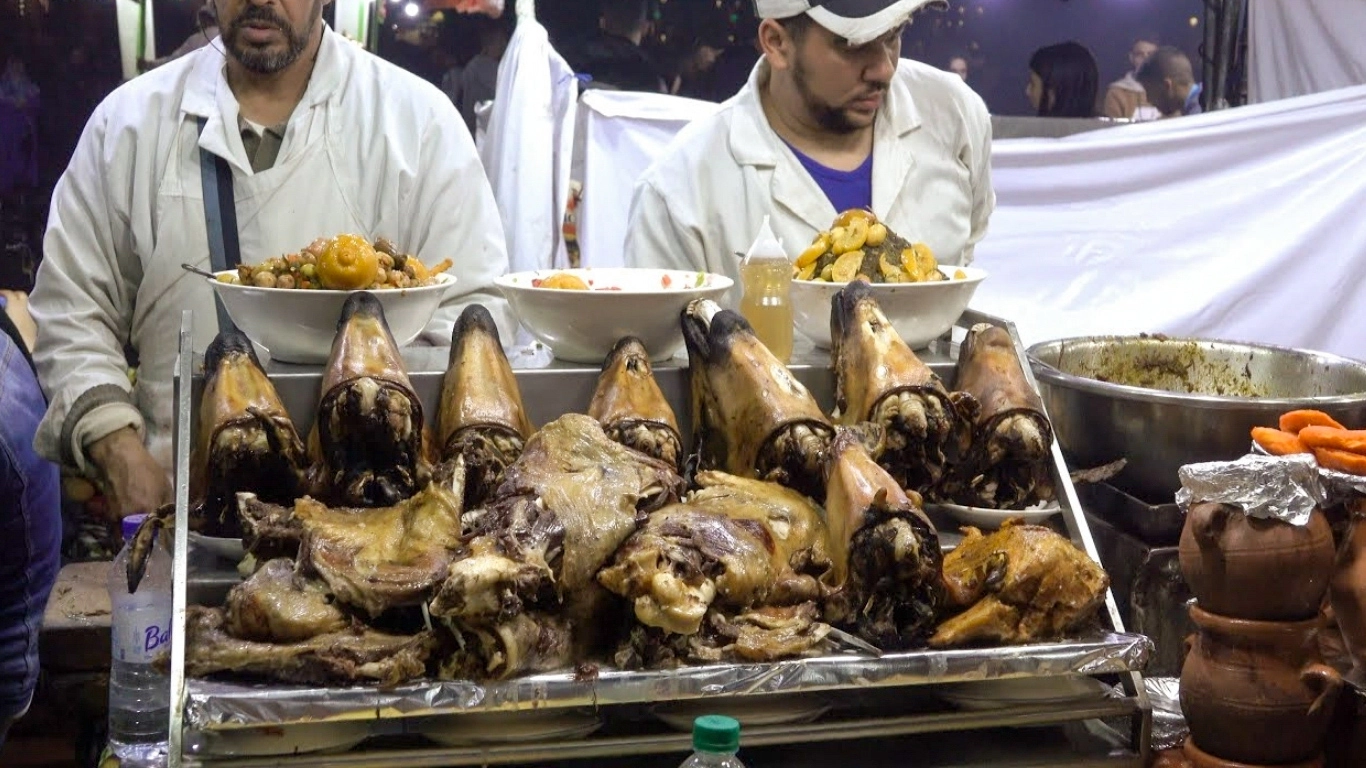
Yes, we Moroccans eat sheep’s head, and it’s not as scary as it seems. The idea might shock you at first, but the taste is something else entirely.
Little anecdote: In my childhood, I used to see my family as “dinosaurs” when I watched them eat sheep’s head, but when I grew up and tried it for the first time, I discovered the meat’s deliciousness and regretted all the years I wasted refusing it.
What is it?
A sheep’s head cooked by steaming, similar to how couscous is cooked, usually served divided. You eat the cheeks, tongue, and brain, with cumin, salt, and bread.
Where to eat it?
In Jemaa el-Fnaa Square at specialized stalls, or in some neighborhood alleys. You’ll rarely find it in a big tourist restaurant, but in simple places known to locals.
Why is it considered an extreme experience?
- Because you’re not just eating meat—you see the head in front of you, and that’s a psychological test for many visitors.
- On the other hand, the meat is usually very tender and rich in flavor, especially the cheeks and tongue.
Is it suitable for everyone?
No. If you get queasy quickly or like your food “hidden” in a pretty plate, this might not be for you. And that’s perfectly fine.
Roasted Sheep at “The King’s Cook”
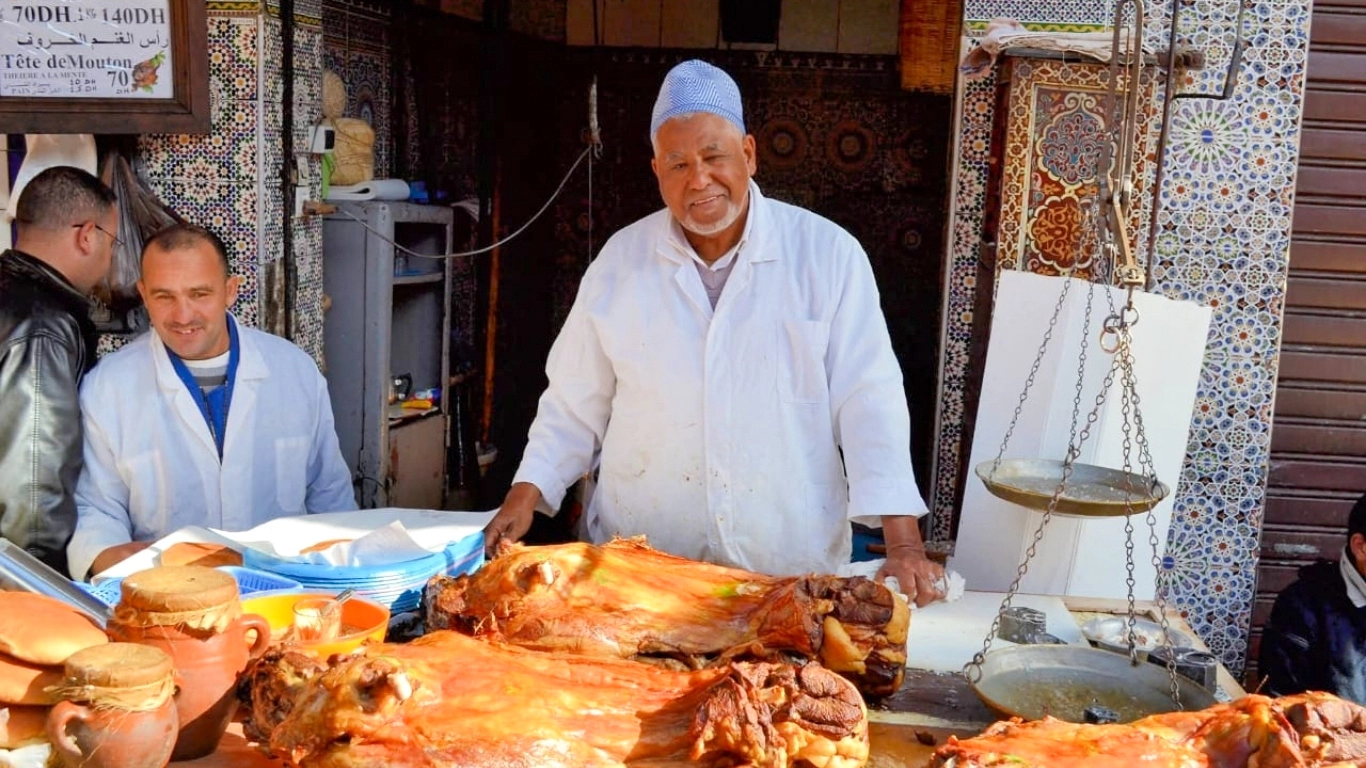
We just talked about the sheep’s head; now we move to the “lower part” at one of Marrakech’s most famous mechoui spots, popularly known as the place that cooked for the late king.
What is it?
Mechoui is a whole sheep (usually without the head) slow-cooked in an underground clay oven until the meat melts in your mouth. It’s usually served as pieces of meat with bread, salt, and cumin only.
Where to eat it?
Near Jemaa el-Fnaa Square, in Mechoui Alley, you’ll find Chez Lamine’s famous shop, along with others. Prices are reasonable compared to the meat quality, and you can share a piece with one or more people.
Why is this place unusual?
Because it combines a “local legend” (king’s cook) with a very primitive eating experience: meat, bread, and your hands. No fancy decor or artistic plating, but honest, strong flavor.
Traditional Hammam… Not a Spa
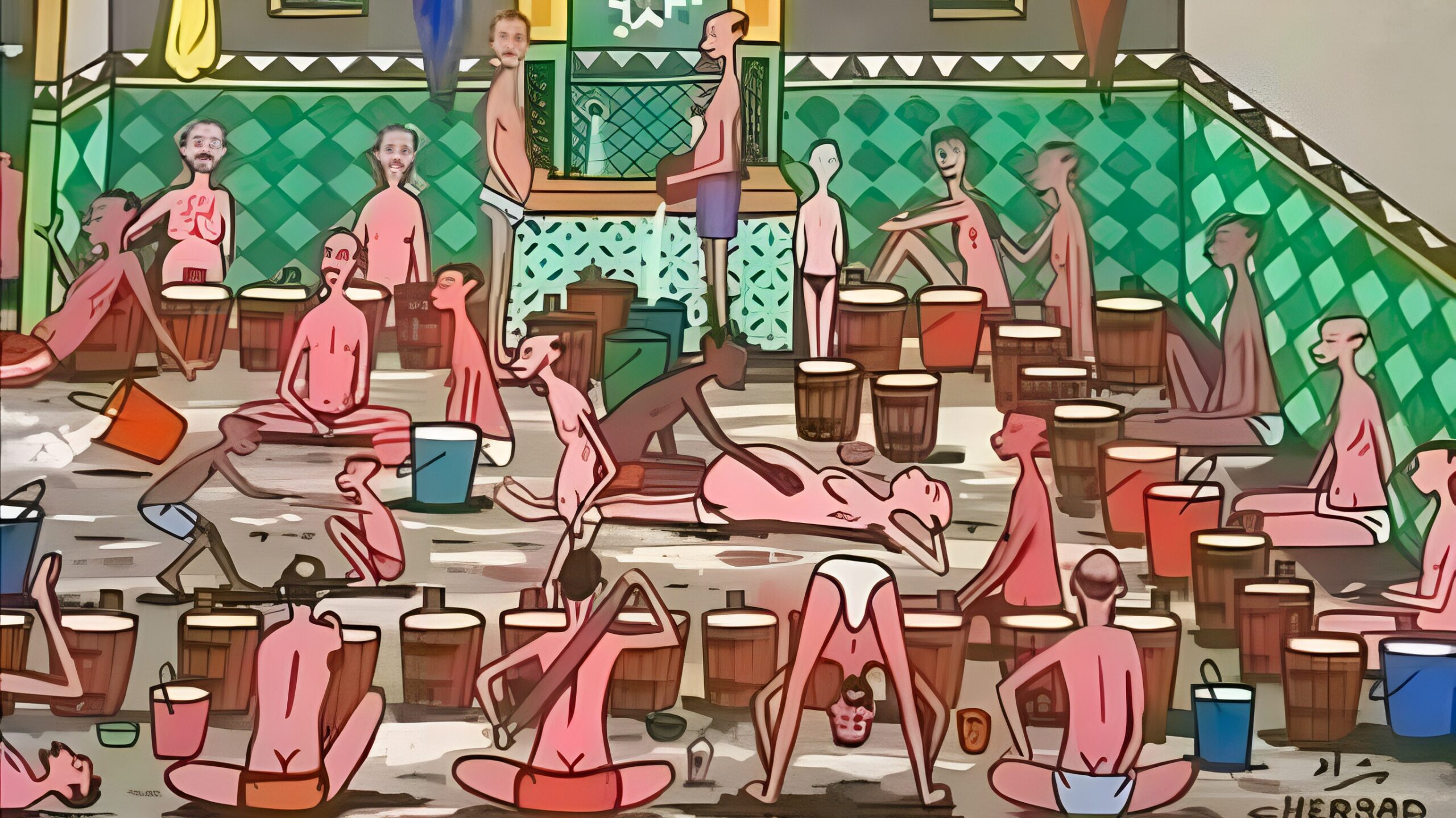
Before writing these lines, I had just returned from a hot traditional hammam. In this cold weather especially, nothing restores your body like a Moroccan hammam.
What is a Moroccan hammam?
“Hammam” simply means a place for bathing, but it’s not a fancy spa. It usually consists of three rooms:
- A very hot room to prepare the skin.
- A medium-heat room for the scrubbing stage.
- A cooler room for the final wash with soap and water.
You come out feeling like you’ve shed a week of fatigue, and for many Moroccans, it’s a weekly routine and also part of wedding preparations for women.
I wrote a detailed article titled “Moroccan Hammam for Beginners: Step-by-Step Guide (From a Local)” I recommend reading it if you want more details.
Why is it unusual for tourists?
- Because you completely step out of your comfort zone:
- A shared space with locals.
- Partial nudity according to custom.
- Sounds, conversations, laughter, and shouts from the scrubbers.
This experience isn’t a “five-star spa”—it’s the heart of the neighborhood and people’s routine.
How to prepare?
- Bring with you: swim shorts, flip-flops, towel.
- The rest you can buy at the hammam entrance: black soap, rough kessa glove, regular soap, shampoo, and comb.
- You can scrub your body yourself, which I recommend for the first time. For your back, you’ll usually find someone next to you happy to help, as long as you return the favor.
Who is this experience for?
For those who want to understand daily Moroccan life, not just tourism’s facade.
If you don’t like being touched or feel very shy, you can stick to a private hammam or spa, but you’ll miss the authentic popular experience.
Hijama (Cupping): The Ultimate Body Reset Before Activities
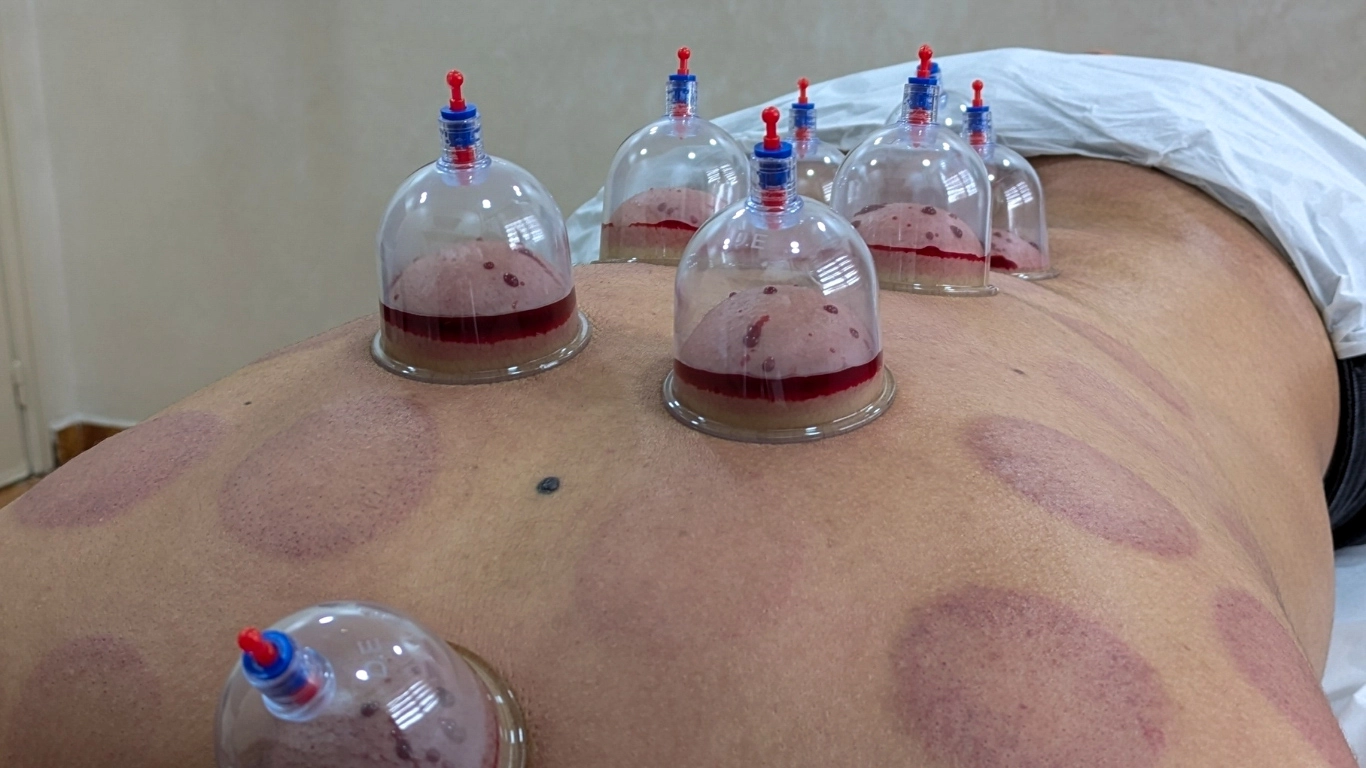
Before I traveled to Marrakech, I went for hijama, and it turned out to be a truly unusual experience.
It was not just a regular appointment — I chose the full package, combining a relaxing massage, a hot towel, dry cupping, and wet cupping.
From the first moment, I felt like I was entering one of those experiences that make your body feel lighter, almost like a feather.
In Morocco, hijama is not just an old practice. It is part of the popular culture, and many people still turn to it for comfort, relief, and recovery from fatigue.
What I liked most was the feeling after the session: lightness, relaxation, and a kind of physical calm that stays with you even after it ends.
It is one of those experiences that is difficult to describe properly, but easy to appreciate once you try it.
As a travel blogger who spends long hours sitting in front of a computer, the tension in my back and shoulders builds up quietly, until you really notice it only when you lie down under the hot towel.
That part alone already helps prepare the body, opening the pores and setting the stage for the main session.
For me, hijama is not just about cupping — it feels like a way to release the physical and mental pressure that has been building up over months of work.
Local advice: if you are planning a long trip to Marrakech or other cities, or if you are about to try something active like paragliding or hot air balloon, do not start your journey with a tired body.
A full hijama session at a trusted center can make you feel surprisingly light, as if you have dropped extra weight from your shoulders.
It is a great way to begin your adventure with a better mood and a body ready for the city’s challenges.
So… Ready to Taste the Real Marrakech?
This list isn’t the “most beautiful” things in Marrakech, but perhaps the strangest and closest to the city’s true soul.
Its goal is to add one or two activities to your program that make your Marrakech story different from everyone who stuck to gardens and palaces.
You can always say, “No, this is too much for me,” and that’s your right. But if you try just one of these experiences, you’ll likely have something to talk about Marrakech for years.